Technology can be a pain.
Turns out scrunching over your smartphone isn't that smart for your body.
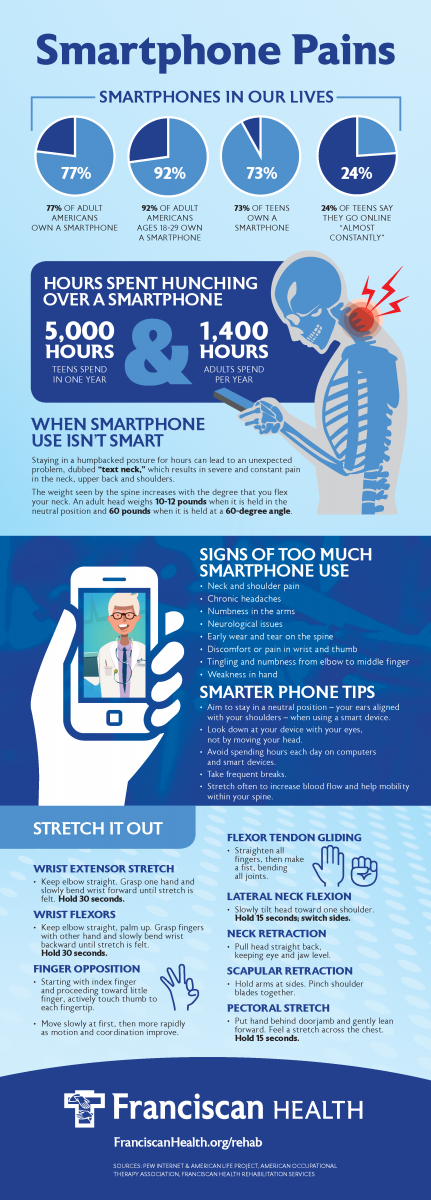
American adults spend an average more than 5 hours on their smartphones every day and more on laptops and computers, meaning they may be looking down or slouching for long periods of time. As a result, people can experience muscle stiffness, joint inflammation, pinched nerves, arthritis, and even bone spurs or herniated discs. This poor posture also can lead to health issues such as chronic pain in the back, neck and knees, circulation problems, heartburn and digestive problems
Terms like "cell phone neck," "smart phone thumb" and "cell phone elbow" - all caused by the bodily positions and repetitive motions from smartphone use - are becoming more prevalent, causing what is really tendinitis in the neck, wrists, elbows or hands.
"We see a lot of people," said Franciscan Health physical therapist Jason Hutchison, PT, DPT. "You see a lot of neck pain in patients that is more repetitive in nature than traumatic, like from a car accident."
Hutchinson, Rehabilitation Services Supervisor at Franciscan Health Mooresville, has seen an increasing number of patients with neck, wrist and hand pain concerns stemming from technology use over the last decade. And he's not alone. A study published in the journal Muscle and Nerve found a link between extended use of smartphones and other hand-held electronic devices and a greater likelihood for wrist and hand pain associated with carpal tunnel syndrome.
The good news? The pain is preventable.
Posture Fixes For Neck Pain
Even slight misalignment can put a lot of strain on the body. A typical adult head weighs 10 to 12 pounds. For every inch your head moves in front of your body, 10 pounds of pressure is added to your shoulders, said Nathaniel Melendez, an exercise physiologist at Orlando Health's National Training Center in Clermont, Fla. Bending it at a 45-degree angle increases the force on the neck to nearly 50 pounds.
"If, for example, your head is 4 inches in front of your body when you're looking down at your phone, that's like having a child sitting on your shoulders that whole time," he said.
"Change your posture," Hutchison said. "Bring the phone to eye level instead of bringing your eyes down to it. Also, stretching is big. Texting is similar to typing in that it's repetitive in nature. Take a break."
Instead of texting, switch it up by using your forefinger instead of your thumb to swipe the screen. Use your voice to dictate a message or make a phone call. Take advantage of word predictions when typing on a smart phone.
Keep messages short. Use abbreviations and word predictions when typing on a smartphone.
Use the device wisely. Avoid cradling the phone between your neck and shoulder. Instead, use a hands-free function like speakerphone or Bluetooth.
Give your eyes a break too. Look at least 20 feet away every 20 minutes to refocus your eyes. When purchasing a smart phone or tablet, consider selecting a larger screen size which will lessen the chance for eye strain.
Stretch Hands, Neck and Wrist Often
Franciscan Health Rehabilitation Services has compiled stretches that can help with tension in the neck, wrist and hands as a result of too much smartphone time.